Written by Jim Foose | Speedway Action Magazine
The eulogy for the weekend warrior has been written a hundred times. For decades, the narrative in American motorsports has been one of slow decline. The local dirt ovals and paved bullrings—once the beating heart of Saturday night entertainment—have faced dwindling car counts, rising costs, and encroaching suburban development. Pundits claim that the spirit of the backyard mechanic, the guy or gal who builds a stock car in their garage after clocking out of their day job, is a relic of a bygone era.
But the pundits are looking in the wrong place. Grassroots stock car racing isn’t dead. It just got weird, bought a $500 rusted-out station wagon, and finally learned how to turn right.
Welcome to the 24 Hours of Lemons, the riotous, oil-stained savior of amateur motorsports.
Taking over premier road courses across the country—from Sonoma to Summit Point—Lemons has successfully captured the chaotic, community-driven spirit of early short-track racing and injected it into multi-day endurance events. It is a brilliant, beautiful mess of automotive enthusiasm, proving that the desire to go wheel-to-wheel with your friends hasn’t vanished; it simply required a new financial model.
The Grid of Misfit Toys

If you attend a traditional oval race, you expect a field of standardized chassis—late models or modifieds that, underneath the fiberglass, are largely identical. Lemons throws that homogenization out the window. The entry list for a typical Lemons race reads like the inventory of a junkyard that suffered a localized tornado.
Because the rules actively encourage absurdity and creativity, the variety of vehicles permitted is staggering. On any given weekend, you might see:
- A clapped-out 1994 Ford Taurus going door-to-door with a BMW E30 that has been entirely covered in astroturf.
- A Plymouth Voyager minivan actively out-braking a gutted Mazda Miata.
- A former police-issue Ford Crown Victoria wearing a giant foam pirate hat on its roof.
This is the modern “stock car” in the truest sense of the word. These aren’t purpose-built race cars; they are daily drivers dragged back from the brink of the crusher, resurrected by sheer willpower, zip-ties, and a profound sense of irony.
The $500 Rule: Racing on a Shoestring
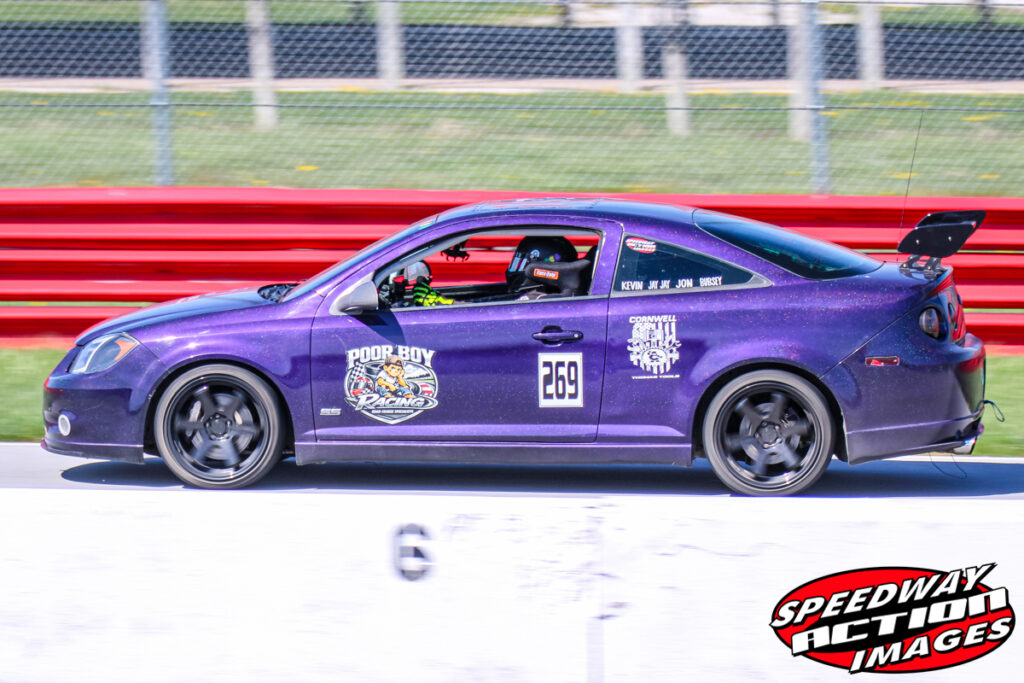
The magic of Lemons, and the reason it has successfully picked up the mantle of grassroots racing, lies in its radical approach to cost containment. The fundamental rule of the series is elegantly simple: You cannot spend more than $500 on your car.
To prevent “cheater” teams from bringing a $50,000 sports car and claiming they bought it for a song, Lemons employs a famously theatrical tech inspection process. A panel of “B.S. Judges” rigorously evaluates every car. If they believe you spent more than $500, they will assign you penalty laps before the race even begins—sometimes in the hundreds.
“You can’t buy your way to the podium here. You have to wrench your way there.”
This rule mandates sweat equity. To get a decent car under the $500 cap, teams must aggressively sell off interior parts, stereos, and trim pieces to recoup their initial purchase price. It levels the playing field, ensuring that victory (or, more likely, just finishing) relies on mechanical ingenuity and endurance rather than the size of a team’s bank account.
Cheap Cars, Priceless Safety

With a grid full of $500 jalopies rocketing down the back straightaway at triple-digit speeds, one might assume the events are a death trap. In reality, the exact opposite is true. Lemons has arguably the most stringent safety standards in amateur racing.
While the car itself must be dirt cheap, safety equipment is strictly exempt from the $500 budget cap. In fact, the organizers demand professional-grade protection:
- Roll Cages: Every car must have a comprehensively welded, multi-point roll cage that meets strict dimensional and structural guidelines.
- Driver Gear: SFI- or FIA-certified racing suits, helmets, gloves, and shoes are mandatory.
- Restraints: Five- or six-point harnesses, modern racing seats, and head-and-neck restraint systems (like a HANS device) are completely non-negotiable.
- Fire Suppression: Cars must be equipped with onboard fire suppression systems and kill switches.
The result is a fascinating juxtaposition: a driver wearing $2,000 worth of state-of-the-art safety gear, strapped into a $3,000 roll cage, piloting a $500 Dodge Neon. It ensures that when the inevitable blown tires, spun bearings, and wall-taps happen, the drivers walk away laughing, ready to patch the radiator with J-B Weld and get back out there.
The New Saturday Night

The 24 Hours of Lemons proves that the heart of grassroots racing was never actually about the shape of the track or the specific horsepower of a V8 engine. It was always about the camaraderie of the pits. It was about standing around a glowing engine bay at 2:00 AM with three friends, sharing a flashlight, trying to swap a transmission before the green flag drops on Sunday morning.
Grassroots stock car racing hasn’t died; it has evolved. It traded the bullring for the road course, the fiberglass for rusted sheet metal, and the endless pursuit of horsepower for the hilarious pursuit of survival. And honestly? The sport is better off for it.

As the official 2026 health and wellness partner of Speedway Action Magazine, Recrea Health & Wellness is dedicated to helping the Northeast Ohio racing community achieve peak performance on and off the track. From advanced recovery therapies to hormone optimization and weight loss programs, their Medina clinic provides the care you need to stay energized for those long hours in the garage. Discover your optimal health at recreahealth.com.
About the Author

Discover more from Speedway Action Magazine
Subscribe to get the latest posts sent to your email.